
Deeds of covenant are a common feature of property transactions in the UK, typically associated with deals involving ‘leasehold’ premises.
Any qualified and experienced conveyancing professional will be well placed and completely comfortable in addressing any issues associated with deeds of covenants on your behalf as a property buyer.
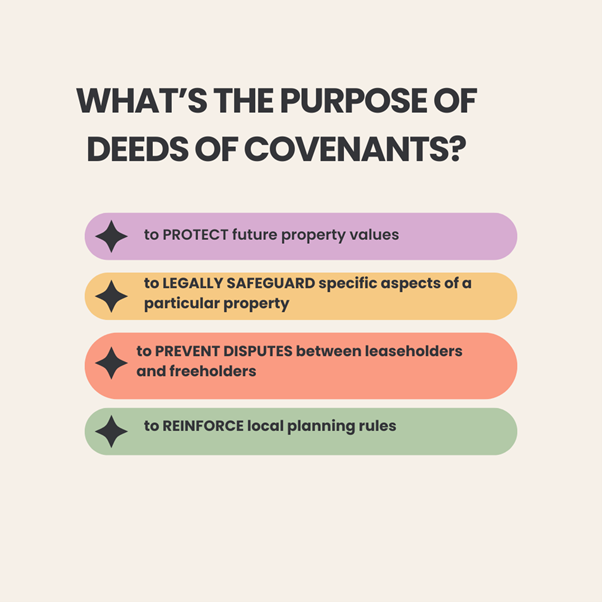
In essence, a deed of covenant is a document or set of documents that (once signed by the relevant parties) legally enshrines certain responsibilities to the owners of specified properties.
By agreeing to sign deeds of covenant when acquiring a property, a buyer is making a commitment to abide by the deeds and details of an associated covenant.
When might a property purchase be accompanied by a deed of covenant?
A deed of covenant appears as a feature of the home buying process when a third party has an interest in the land or building within which a specific property lies, such as when a house or a flat is categorised as ‘leasehold’.
The third party involved will generally be a property management company or a designated freeholder, who doesn’t own your property but nonetheless wants to see certain commitments being made and kept with regards to it.
There are two main types of covenant:
- Positive covenants –a positive covenant amounts to a promise made on the part of a property buyer to, for example, pay a routine service charge or to maintain the condition of specific areas or dividing walls designated on a plan associated with an ownership transfer.
Restrictive covenants – a restrictive covenant reflects a commitment on the part of a buyer not to take certain actions in relation to the property they’re acquiring the leasehold on. Such a covenant might insist, for example, that new owners of a property don’t turn it into multiple dwellings or don’t restrict access via paths as specified within relevant documentation.
Understanding your obligations
Deeds of covenant might seem like a worrying complication to your property buying process but in fact they are generally quite routine and easily addressed by any experienced conveyancing solicitor or service provider.
What’s most crucial for buyers is to understand precisely what legal obligations they are entering into when signing deed of covenant documentation.
For conveyancers, the paperwork involved is not usually burdensome or problematic, and, for buyers, there is usually a straightforward decision to be made about whether or not they’re happy to make the commitments being asked of them.
Sometimes the details of demands being made via deeds of covenants become obsolete over time anyway and so all parties involved in a transaction can simply disregard them.
Legal ramifications
If buyers take the view that they don’t want to sign a deed of covenant—because it seems odd or irrelevant or overly burdensome—then they are well within their rights to contest the details and ask that they take ownership of the relevant property’s leasehold without signing a deed of covenant.
On the other hand, it is often the case that a property legally cannot be sold or have ownership transferred without the prospective new owners having committed to deeds of covenant as relevant.
Crucially, perhaps, the third parties with an interest in the land or the building the property sits on or within can prevent a sale from happening if they wish to do so.
Also, once a deed of covenant has been committed to on the part of a new property owner, they are then legally obligated to stick to the terms of that commitment.
What happens if you don’t abide by the terms of a covenant?
Breaching the terms of a covenant in these contexts can result in legal action being taken by the parties being impacted.
An aggrieved party in these situations can take the signatory of a deed of covenant to court seeking damages for any losses they might have suffered and/or to prevent further breaches of the relevant contracts happening in future.
In practice, courts will generally insist upon sensible resolutions to disputes of this kind that essentially amount to any damage to a property being fixed or changes being reversed.
In the case of positive covenants not being matched by actions, for example, courts will generally just demand that the relevant parties live up to their legal obligations going forward.
With restrictive covenants, if someone has erected a new wall or turned their property into two separate sub-dwellings, for example, the courts might insist that they reverse those actions forthwith.
A covenant will generally be applicable indefinitely, unless the relevant parties and signatories agree to change the terms entailed within the relevant documentation.

The importance of good advice
For prospective homeowners, it’s important to seek advice and guidance from experienced conveyancers if you’re concerned at being confronted by any kind of deed of covenant.
If it’s required as part of a transaction that sees you taking ownership of a new home, then signing a deed of covenant doesn’t need to be viewed as a problem.
However, it is always sensible and likely to be reassuring to take guidance from people who know precisely what to look out for within the details of any associated documentation, and how to overcome or address any potential causes for concern.
How we can help
Home Legal Direct connects property buyers and sellers with highly reputable and reliable conveyancing experts across the UK.
You can get quotes from dozens of quality service providers in seconds via our website. Plus, our own in-house experts are always available to respond to queries relating to deeds of covenants or any other issues arising within the context of a residential property purchase.